


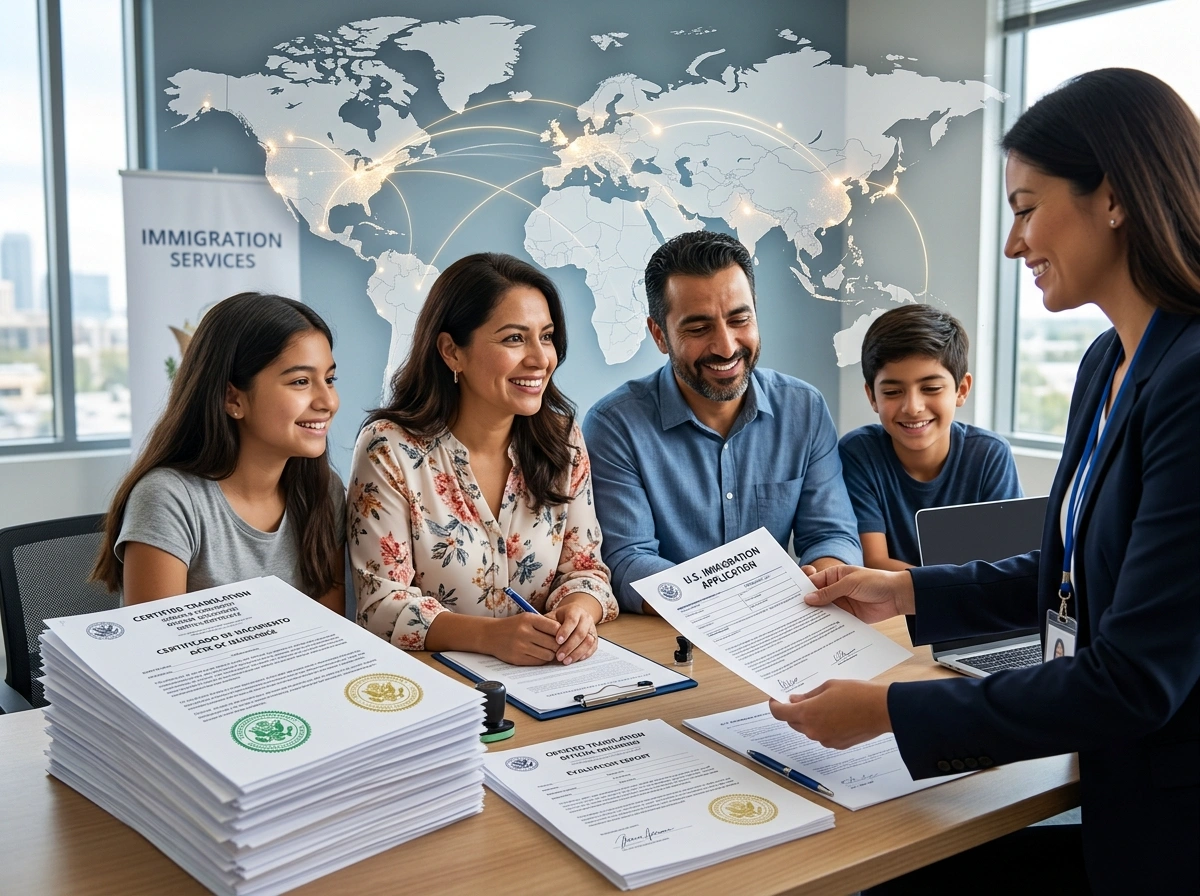
Navigating the immigration system often feels like an uphill battle. Applicants face a mountain of paperwork, strict deadlines, and complex legal requirements that can overwhelm even the most organized individuals. Moving to a new country brings immense logistical challenges, and the bureaucratic hurdles only add to the stress. Every form must be filled out perfectly, and every supporting document must meet exact government standards.
Language barriers introduce an entirely new layer of difficulty to this already rigorous process. Government agencies require all foreign-language documents to be submitted in English. An applicant cannot simply provide their original papers and hope the reviewing officer understands them. Officials need exact, legally binding English versions of these records to verify identity, background, and eligibility.
This requirement is a common stumbling block for many hopeful immigrants. A single mistranslated word or a missing signature can trigger severe consequences, ranging from extended processing delays to outright application denials. Fortunately, securing professional certified translation services provides a clear, reliable solution. By partnering with experts who understand government standards, applicants can protect their cases and move forward with confidence.
The Complexity of the Immigration Process
Applying for a visa, green card, or citizenship requires intense attention to detail. Applicants must prove their identity, marital status, financial stability, and criminal history. Providing this proof involves gathering documents from various stages of life, often from different countries and jurisdictions.
Government adjudicators review these files with extreme scrutiny. They look for inconsistencies, errors, and missing information. If an immigration officer cannot read or authenticate a foreign document, they will issue a Request for Evidence (RFE). An RFE pauses the entire application process until the applicant provides the corrected materials. Resolving an RFE takes time, costs extra money, and significantly elevates the applicant’s stress levels.
Because the stakes are incredibly high, precision is mandatory. Immigration officials deal with thousands of cases daily, meaning they do not have the time to decipher poor translations or overlook formatting errors. Providing clear, compliant documentation from the start is the only way to ensure a smooth review process.
What are Certified Translation Services?
A certified translation is a specialized document translated by a professional who verifies its exactness. It is not just a standard word-for-word conversion. Instead, it includes a formal Certificate of Accuracy. This certificate is a signed and dated statement from the translator or the translation agency.
The Certificate of Accuracy affirms that the translated text is a complete, true, and correct rendering of the original document. It also states that the translator is fully competent to translate from the source language into English. Government agencies, courts, and universities require this formal attestation to trust the validity of the document.
Without this signed certificate, a translated document holds no legal weight in the United States. A bilingual friend or a digital translation app cannot provide this level of certification. Professional translation agencies utilize native-speaking linguists who understand exactly how to format and certify these documents to meet strict institutional guidelines.
The Role of Translation in Immigration Documentation
Translations serve as the vital bridge between your history in your home country and your future in the United States. Immigration officers use your documentation to verify your life story. If you were born in Spain, married in Japan, and attended university in Mexico, the United States Citizenship and Immigration Services (USCIS) needs a way to verify all those events in English.
Professional translators ensure that names, dates, and official seals carry over accurately. They understand how to handle culturally specific terms, unique government titles, and complex legal phrases that do not have direct English equivalents.
Furthermore, translators mirror the format of the original document. If your birth certificate features specific tables, stamps, and signatures, the translated version will reflect that exact layout. This visual consistency helps immigration officers quickly compare the original foreign document to the English translation, speeding up their review process.
Why USCIS and Other Agencies Require Certified Translations
The United States government operates under strict federal regulations regarding foreign documents. According to USCIS guidelines under 8 CFR 103.2(b)(3), any document containing foreign language submitted to the agency must be accompanied by a full English translation.
The rule explicitly demands that the translator certify the translation as complete and accurate. The translator must also certify their competence to translate from the foreign language into English. USCIS enforces this rule to prevent fraud, misrepresentation, and processing errors.
Other organizations maintain similar standards. If you are applying for a driver’s license, the Department of Motor Vehicles (DMV) needs certified translations of your foreign license. If you are involved in a legal dispute, federal and state courts require certified English evidence. Universities assessing international applications also demand certified transcripts to evaluate academic credentials accurately.
Common Documents Requiring Translation
Immigration applications require a wide variety of supporting evidence. Depending on your specific visa or residency category, you may need to submit several different types of official records.
Identity and Civil Records
The most frequently translated documents are birth certificates and marriage licenses. These records prove your identity, age, and familial relationships. Divorce decrees and death certificates are also heavily requested, especially for spousal visas or family-sponsored green cards.
Legal and Financial Documents
Many visa categories require proof of good moral character and financial stability. Applicants often need certified translations of police background checks and criminal records. Additionally, business investors and employment-based visa applicants must submit translated tax returns, bank statements, and business incorporation documents.
Academic and Medical Records
Students and skilled workers frequently need their academic transcripts and university diplomas translated for credential evaluation. Furthermore, immigrants applying for permanent residency must undergo a medical examination. If you have foreign vaccination records or specific medical histories, you will need those documents translated for the USCIS-approved civil surgeon.
How Professional Services Ensure Accuracy and Compliance
Professional translation companies build their entire business models around accuracy and legal compliance. They employ highly vetted, native-speaking linguists who specialize in legal and official translations. These experts understand the specific dialects, regional nuances, and historical changes in the languages they translate.
Quality control is a major factor in professional services. Top-tier agencies utilize a multi-step review process. After the initial translation, a second linguist often proofreads the text to catch any typographical errors, missing words, or formatting inconsistencies.
Furthermore, reputable agencies maintain memberships with organizations like the American Translators Association (ATA). This affiliation demonstrates a commitment to professional ethics and industry standards. By working with an established agency, you guarantee that your documents meet the rigorous expectations of U.S. government officials.
Avoiding Delays and Rejections with Certified Translations
Cutting corners on document translation usually leads to disastrous results. Some applicants attempt to translate their own documents to save money. Others ask bilingual family members for help or rely on automated translation software.
USCIS strictly forbids applicants from translating their own documents. Furthermore, automated software often misinterprets legal jargon, resulting in nonsensical English sentences. When an adjudicator encounters an informal, uncertified, or poorly translated document, they will reject it immediately.
This rejection triggers a Request for Evidence. An RFE gives you a limited window to submit a proper, certified translation. While you scramble to find a professional translator and wait for the documents to arrive, your immigration case stalls completely. In worst-case scenarios, failing to respond to an RFE adequately will result in a final denial of your application. Securing professional translations from the very beginning eliminates this risk entirely.
The Peace of Mind Provided by Professional Translators
The immigration journey is notoriously exhausting. Applicants spend months, sometimes years, worrying about their legal status, their families, and their futures. The administrative burden of compiling a perfect application file takes a heavy emotional toll.
Hiring a professional translation service removes a massive weight from your shoulders. You do not have to worry about formatting tables, searching for the correct legal terminology, or drafting a Certificate of Accuracy. You simply upload your digital documents to a secure portal and let the experts handle the rest.
Knowing that your translations are guaranteed to be accepted by USCIS provides invaluable peace of mind. You can submit your application packet with the confidence that language barriers will not derail your American dream.
Frequently Asked Questions
Understanding the technicalities of document translation can help you make informed decisions about your application. Here are a few common questions applicants have about the process.
Can I translate my own documents for USCIS?
No. USCIS policies do not allow you to translate your own documents, even if you are completely fluent in both English and your native language. The translation must come from an objective, competent third party who signs a Certificate of Accuracy.
What is the difference between a certified and a notarized translation?
A certified translation includes a signed statement from the translator affirming accuracy and competence. This is sufficient for USCIS. A notarized translation takes the process one step further. A Notary Public witnesses the translator signing the Certificate of Accuracy and stamps the document with their official seal. Some state courts, universities, and financial institutions require notarized translations, but USCIS generally only requires certification.
How much do certified translations cost?
Pricing typically depends on the length and complexity of the document. Many professional agencies offer transparent, per-page pricing. For example, standard birth certificates or marriage licenses often start at around $29.95 per page. This flat-rate approach prevents hidden fees and allows applicants to budget accurately for their immigration expenses.
Do I need to mail my original documents to the translator?
Most modern translation agencies do not require physical originals. You can safely scan your documents or take clear, high-resolution photographs with your smartphone. You simply upload these digital files through the agency’s secure website. The final certified translations are then emailed back to you as PDF files, which you can print and include in your USCIS application package.
Streamlining Your Path to Immigration Success
Securing legal status in the United States requires patience, organization, and a strict adherence to federal rules. While the sheer volume of requirements may seem daunting, you do not have to tackle every obstacle alone.
Your foreign documents tell the story of your life, education, and family. Ensuring those documents are accurately conveyed in English is a critical step in your journey. Professional translators provide the accuracy, formatting, and legal certification required to satisfy the most demanding government agencies.
By investing in proper translations early in the process, you protect your application from unnecessary delays and frustrating evidence requests. You clear the path forward, allowing immigration adjudicators to review your case swiftly and favorably. Take control of your application today by organizing your foreign records and securing the professional translations you need to succeed.
